Boom...Morgan
Showing posts with label Fishing Knowledge. Show all posts
Showing posts with label Fishing Knowledge. Show all posts
Wednesday, May 23, 2018
Fishing Knowledge
For those of you who are new to the game or a vet, always great to brush up on new knots or see someone else's technique. This is my go to saltwater fly or baitfish/streamer knot...
Boom...Morgan
Boom...Morgan


Saturday, April 28, 2018
12th Annual Project Healing Waters 2-Fly Tournament

Its finally here! One of my favorite weekends of the year, 2-Fly weekend! I'm packing up the truck as soon as I finish pounding these keys and heading south to Syria, VA for the 12th Annual PHWFF 2-Fly Tournament! Here are the details you need to know along with a few links to follow along via social media all weekend long!
Saturday
Bluegill Tournament
- 10:00 a.m. – 2:00 p.m. Bluegill tournament at the Rose River Farm pond.This will be a fun “pre-tournament” event on the Rose River Farm pond for PHWFF participants and anglers competing in Sunday’s tournament.
- 4:45 p.m. (approximately) -PHWFF program participants in this year’s 2-Fly will be escorted by the Patriot Guard Riders from Culpeper to the Rose River Farm on Saturday night.
- 5:00 – 8:00 p.m. Dinner at Rose River Farm.
Open to all volunteers and participants in the 2-Fly — RSVP is required via the Evite announcement sent to all registered volunteers, participants and guests.
SUNDAY
- 7:00 a.m. check in begins (coffee, doughnuts, and light snacks)
- 7:15 – 7:30 rules briefing and beat assignments
- 7:30 – 7:40 team photos
- 7:45 National Anthem
- 8:00 – 9:30 round one fishing for 15 teams (teams time slots will be picked at random)
- 10:00 – 11:30 round one for the 15 other teams
- 11:00 – 12:30 Lunch
- 12:00 – 1:30 round two for the first 15 teams
- 12:30 – 1:15 Fly Fishing Clinic
- 2:00 – 3:30 round two for the other teams
- 2:30 – 3:15 Fly Fishing Clinic
- 3:30 – 4:00 score tally relax time and other activities
- 4:00 Awards Ceremony
All Day
- Clinics with Fly Fishing Experts Check for posted times
- Rod Demo
- Bass and Bluegill fishing in the 2 ponds (fly only)
- Free streamside broadband courtesy of Virginia Broadband.
Saturday, April 21, 2018
Redington's "The Loop" - Ep. 1
In today's episode of In The Loop, field correspondent Cam Sneakerton investigates some common mistakes made by anglers when approaching the river. Watch as Cam breaks down the approach and attire of one of fly fishing’s biggest celebrities on his latest fishing adventure. This in-depth analysis will give you the insight you need to avoid simple but costly mistakes the next time you’re out on the water.
To see more info on this episode and the gear used, check out Redington's The Loop.
Boom...Morgan
Maryland Weekly Fishing Report - April 21st, 2018
Via MD DNR:
By: Keith Lockwood
Today, April 21, is a big day for those who dream of catching a trophy striped bass. More than a few anglers will spend the night before checking alarm clocks just to find themselves waking up a half-hour before the alarm is set to go off anyhow.
Weather is predicted to be a little nippy in the morning but should warm up as the day progresses. It will be a wonderful day to be out on the water with family and friends.
Before we get into this week’s fishing report, I want to remind everyone that they can submit their own fishing reports and photos to the Maryland Angler’s Log. To post a report, please email your name, hometown, photos, location and additional content for your report. All information is optional, but encouraged.
The striped bass spawning in the Choptank, Nanticoke, Patuxent and Potomac rivers is behind schedule due to colder than expected water temperatures, and spawning in the upper Chesapeake Bay is most likely weeks away. This week the spawning area in the Choptank River registered 56 degrees and there is a minor amount of spawning occurring. Usually spawning begins at 60 degrees and is optimal at 64.5 degrees, so many female striped bass are still holding in the spawning reaches. Based on predicted weather forecasts, it may be another week or so for water temperatures to be correct in that area.
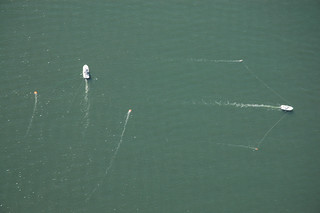
This photo taken from a helicopter shows planer board trolling gear deployed, a situation you do not want to find yourself in when trolling. Photo by Keith Lockwood
Those out trolling Saturday will most likely be kept busy clearing lines of winter jellies which are being swept along the steep channel edges. Unfortunately these are the same locations where the most optimum trolling will take place for striped bass. Winter jellies are actually lion’s mane jellyfish which are moving down the bay as part of their life cycle.
Pre-spawn striped bass will be the most common large fish being caught and it will be a tough decision for some to keep these fish or release them. The minimum size for striped bass during the trophy season is 35 inches. Chartreuse and white bucktails and parachutes in 2-6 ounce sizes will be the most common lures used and will be set to cover a wide variety of depths when searching for fish. Trolling speeds are often about 3 knots and the trolling pattern is perpendicular to the shipping channel edges.
Saturday, March 10, 2018

Tuesday, February 20, 2018

Thursday, February 1, 2018
Mid-Winter Maryland Fishing Report: January 31
Via MD DNR:
By: Keith Lockwood
Boom...Morgan
By: Keith Lockwood
Maryland started off 2018 with a deep freeze, and it remains to be seen what old man winter has in store for us in the next month. But as long as temperatures remain relatively moderate, there are all kinds of fishing adventures out there from the Atlantic Ocean to Mountain Maryland.
Anglers in the tidal waters of the Chesapeake Bay are mostly pursuing yellow perch and catfish species in the middle to upper regions of the tidal rivers. Water temperatures are holding in the mid to upper 30s in most tidal rivers and yellow perch are holding in some of the deeper areas, waiting for warmer water temperatures next month. Often these deeper holes can be found near narrow bends in the rivers and a good depth finder can help locate where the perch are stacked. A bottom rig baited with a minnow is always a good bet to catch them.
Before we get into this week’s fishing report, I wanted to remind everyone that they can submit their own fishing reports and photos to the Maryland Angler’s Log. To post a report, please email your name, hometown, photos, location information and additional content for your report. All information is optional, but encouraged. New reports are posted daily during the busy fishing seasons.
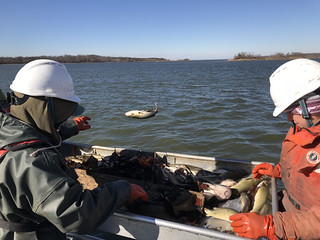
Biologists are conducting the annual winter trawl survey aboard the NOAA research vessel Chesapeake out of the Cooperative Oxford Lab, to acquire data on resident populations of finfish such as white perch, channel catfish and other species in the upper bay tidal rivers. Photo by Captain Mike Simonsen
In large waters — such as the lower Susquehanna River off Perryville, where there is a 40-foot hole where yellow perch traditionally stage — it will take considerable weight to hold bottom. In smaller and more sheltered waters you may be able to get away with as little weight as a couple of split shot. In smaller waters, a tandem rig of small shad darts is standard fare, and a piece of minnow placed on the hook or a small piece of red felt doped with anise or fish oil scents will go a long way to enticing yellow perch to strike.
On sunny afternoons, yellow perch can sometimes be found in shallower waters over dark mud on the sunny side of a river or creek. Casting small shad darts or lip-hooking a minnow with just enough split shot to get it to the bottom can be a good tactic in these areas. Slowly retrieve the minnow a few feet and then pause for a minute or so before reeling in another couple of feet. Of course if the rivers and creeks ice up again, all bets are off until the ice is thick enough to fish through — which at this point is rather doubtful.
If a trophy-sized blue catfish is on your bucket list, the next couple of months are a good time to target them. The deeper parts of the Potomac River channel and sections off Fort Washington are hot spots for this type of fishing. Fresh bait is of primary importance and finding live bait is often the biggest hurdle to this type of fishing — gizzard shad are often the best choice, while bluegills or white perch will work well also. Most anglers put out several stout rods with enough weight to hold bottom. If fresh catfish fillets are on your mind, smaller baits and rigs along channel edges will usually fit the bill. Small blue catfish can also be found in the upper Patuxent and Nanticoke rivers.
Channel catfish are abundant in most of the tidal rivers flowing into the Chesapeake Bay and can be found holding deep in the middle and lower sections of the rivers. Most fresh cut baits will do the trick and if you can keep it on the hook, chicken livers can work well. Nightcrawlers are another good bait, but small white perch can be pesky bait stealers at times.
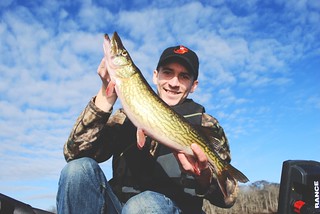
John Horwat enjoyed a day of fishing in his kayak and holds up a beautiful chain pickerel on an Eastern Shore river before slipping it back into the water. Photo by C J Wood
A fish that is active during the winter months and fun to fish for is the chain pickerel. They tend to transcend the limits of tidal waters and freshwater impoundments and can be found in a wide variety of areas. Popular spots to fish during the winter months them include the upper regions of the tidal rivers and creeks. Chain pickerel seem to enjoy cold water and offer anglers a good target for some fun catch and release fishing. Most anything that moves through the water will attract the attention of a waiting chain pickerel — they attack lures with total abandon since they are ambush predators — but certain lures offers better options. Treble hooks on spinners and jerkbaits catch chain pickerel, but unhooking these toothy critters can be difficult and damage gills. A good pair of fishing pliers is a good tool to have on hand. A single hook tends to be more kind to the fish.
Large chain pickerel can be found holding near deep structure or drop-offs near coves. Smaller chain pickerel tend to hold along shorelines often warm themselves over dark bottom on sunny days. Larger chain pickerel can move into shallower areas also as most anglers know fish tend to move around on their own accord so covering a lot of water with lures is a good tactic. Spinnerbaits and swimbaits are good lures to use when covering a lot of water.
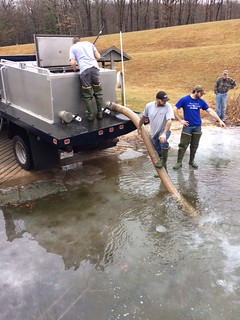
Photo courtesy of Greenbrier Lake stocking crew
The preseason stocking of trout in the put and take areas and other trout management classified waters is well underway and offers good fishing opportunities, often close to home. The stockings are posted on the trout stocking website when they occur.
Besides the traditional creeks and streams being stocked many neighborhood ponds are being stocked. These ponds offer comfortable fishing opportunities for families and especially young children. They can be with mom or dad on solid ground and watch a bobber for the telltale twitch indicating a trout may be interested in what is on the end of one’s fishing line. When fishing for recently stocked hatchery trout, few baits can beat the scent- and color-enhanced commercial dough baits. Garden worms and minnows offer alternatives. Others love to cast small spinners, wooly buggers and the deadly spinner fly, with good reason since one can cover a lot of water and they are trout killers.
Trout stocking crews are working hard to get the trout out and catch up after being held up by the early January freeze. During that time period, hatchery raceways and holding ponds were iced in and made feeding and collection difficult. Once the raceways were clear and trout started to be loaded on trucks, crews used some unconventional methods at times to get trout out to frozen lakes and ponds.
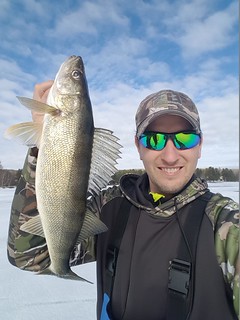
Matt Sell caught this nice walleye through the ice in early January. Photo courtesy of Matt Sell
The cold weather in early January caused ice to develop rapidly throughout all of Maryland from the coastal bays near Ocean City to the Chesapeake Bay and to the far western counties. In the Chesapeake Bay ice in many areas was recorded to be 7 inches thick or more, bringing most boat traffic to a halt. These conditions, coupled with tides that seemed to not come back in for weeks, made it tough on the creatures of the bay and tidal rivers, from oysters to geese.
The ice conditions at Deep Creek Lake, which is perhaps the most popular and famous location to go ice fishing in Maryland, developed rapidly in early January and “hard water” fishing was enjoyed by many. As January rolled on, warmer weather and rain caused deteriorating conditions and the lake currently has open water along the edges and “rotten ice” on the main lake and coves. Time and weather will tell whether ice conditions improve in February and anglers are able to safely get out on the ice once again.
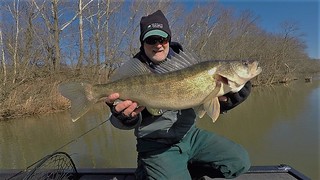
John Mullican holds up a beautiful walleye for the camera before slipping it back into the river. Photo courtesy of John Mullican
But as weather conditions have opened up waters around the state, fish that enjoy cold water — such as walleye and smallmouth bass — are active in the upper Potomac River. Be advised that flows in the upper Potomac River are brisk this time of the year and rain events in the upper watershed can cause conditions to become dangerous very quickly. Smallmouth bass tend to hunker down in what many call “winter holes” where they can get some relief from stiff currents; walleye will also be found in these same areas. Small to medium-sized soft plastic jigs and swimbaits worked slowly close to the bottom can offer some trophy-sized smallmouth bass and walleyes. Through April 15 any walleye greater than 20 inches must be returned to the river, and the minimum size for possession is 15 inches.
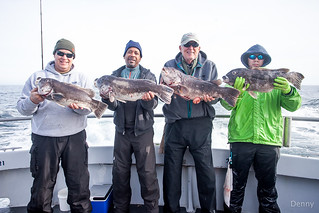
This group braved some chilly temperatures on a trip with an Ocean City party boat and were more than happy to show off part of their catch. Photo by Captain Monty Hawkins
In the coastal areas and Ocean City the few party and charter boats that are heading offshore were locked up in ice in the early part of January. Tautog season is open now with a four-fish per-day limit and a 16-inch minimum until May 15. The tautog are out there and some impressive catches are being made, but weather conditions rule as to when boats can go. Some large flounder have also been caught recently to help spice up any trip. Spiny dogfish have been reported to be pesky at some of the wreck and reef sites, causing boats to move to other promising locations. The water temperatures at the wreck sites is holding around 46 degrees this week. The sea bass season is closed until at least Feb. 28.
Boom...Morgan
Thursday, November 16, 2017
Loon Live TONIGHT!
 |
| LOON LIVE: WELCOME HOGAN BROWN |
| This week on Loon Live we're fortunate to be joined by guide, speaker, tyer, father, fly designer, musician, teacher and northern California legend Hogan Brown. Hogan will be answering your questions about chasing fish on the west coast, especially on his home waters of the Yuba River. We've found that Hogan's bugs work anywhere that trout eat, so we'd highly recommend taking advantage of his time on Loon Live! To learn more about Hogan click here We hope to we see you on Thursday at 6pm PST! |
Boom...Morgan
Friday, October 13, 2017
Flips Tip - The Area of Awareness
Knowledge dropped...checkout the "Flips Tip" label at the bottom of this post for more.
Boom...Morgan
Boom...Morgan
Tuesday, September 26, 2017
Flip’s Tip - Starting Your Cast
Stay tuned as we post a new series from Flip Pallot and Hell's Bay Boat Works to help you with the little things...here is Flip's Tips.
Boom...Morgan
Boom...Morgan
Tuesday, September 5, 2017

Monday, August 28, 2017

Salty Cape Weekly Fishing Report - August 25, 2017
| |||||||
|


Monday, August 14, 2017
Maryland Weekly Fishing Report - August 14th, 2017
Via MD DNR:
By: Keith Lockwood

By: Keith Lockwood
Both lower and high tier views of the Bay Bridge at sunset. Photo by State of Maryland
As I was coming across the Bay Bridge yesterday evening, I could not help but marvel at the schools of juvenile menhaden plying along the calm surface of the bay and drifting along in the currents on both sides of the bay. The bay is truly a bountiful basin of life and on this evening there did not seem to be any hungry striped bass or bluefish nearby. All was calm on the Chesapeake this evening, at least at this area.
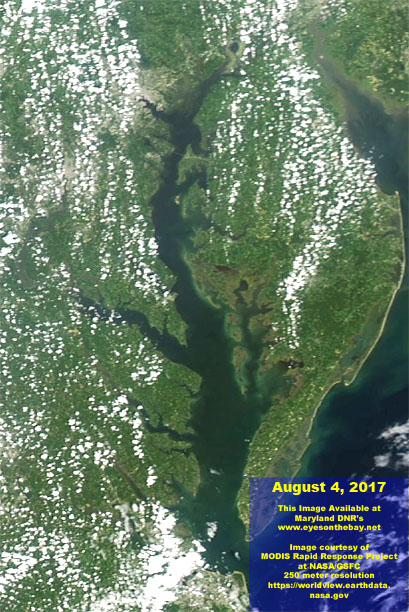
Satellite imagery from NASA
The Conowingo Dam has been releasing a lot of water at mid-day intervals for power generation and there is a lot of discolored water moving down the lower Susquehanna and into the uppermost parts of the bay. It is beginning to clear some in the last six days and hopefully fishing will improve. In this satellite image from August 4, 2017, one can see the stained water coming out of the lower Susquehanna River.
Fishing for striped bass in the upper bay region continues to be one of the best places in the Maryland portion of the bay to consistently find striped bass exceeding 20” in length. The action for those chumming has been the best at Swan and Love Points with the action slacking off this week at Podickory Point. Sub-legal striped bass that are less than 20” are still dominating the chum slicks and also surface breaking fish events. Breaking fish in the areas around Love and Swan Points has been recently offering a fun way to catch some nice fish by jigging underneath the smaller surface striped bass. Breaking fish are being spotted mostly in the early morning and evening hours as striped bass chase juvenile menhaden along channel edges and most of the action lately tends to be on the eastern side of the bay.
Small bluefish have moved into the region and have been nipping at cut baits being drifted back in chum slicks and making short work of live spot being live lined in the region. The good news in regard to live lining spot is that spot can now be found in some of the region’s tidal rivers such as the Magothy and Chester Rivers.
Fishing for white perch remains good this week in the tidal rivers and hard bottom shoal areas in the bay. If you can find wild caught shrimp at the grocery store they make good bait when bottom fishing for white perch as well as peeler crab and the more expensive bloodworms. Fishing close to shore around structure is a fun way to catch white perch with light tackle. Small jigs with soft plastic bodies are an excellent way to fish and tend to not hurt your pocketbook too much when you get hung up. If you can catch your own with a fine mesh net, grass shrimp tend to be the ultimate bait when used on a simple one hook bottom rig or on a small jig fished tight to old dock piers and similar structure.
Wednesday, July 19, 2017

Tuesday, July 11, 2017
Maryland Weekly Fishing Report - July 11th, 2017
Via MD DNR:
By: Keith Lockwood
By: Keith Lockwood
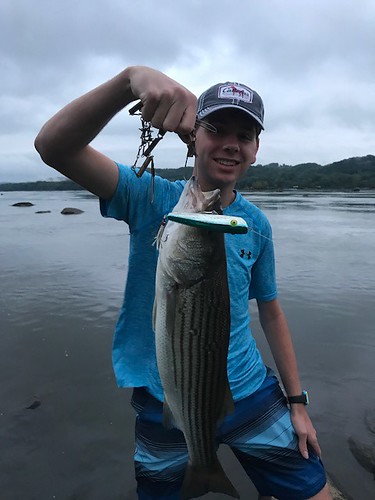
Josh Zylka holds up a nice striped bass caught in the lower Susquehanna on a popper; by Craig Zylka
The holiday weekend is but a memory now and I hope your memories are good ones. It was a scorcher in many areas of Maryland and people flocked to the water for relief. It did my heart good to see fishing rods peeking out through mini-van windows or in the back of pickup trucks as folks headed to their waterside destinations. The summer will tend to move along now and before we know it we’ll be starring Labor Day in the face so don’t put off spending time with family and friends fishing.
The Lower Susquehanna River continues to give up a fair amount of striped bass for those willing to be at the Conowingo Dam pool at sunrise. The power generation releases usually begin before daybreak and continue into the afternoon. Casting heavy swimshads with surf casting gear into the most turbulent parts of the pool has been a great option. Others are having success casting topwater lures in the boulder fields farther down river at sun up.
A few striped bass are being caught around the edges of the flats but most of the action in the upper bay is focused from the Rock Hall area south. Chumming has taken center stage at Swan Point, Love Point and Podickory Point. It has been a good idea to locate suspended fish on a depth finder and anchor up and allow chum and baits to drift into the deeper edges of the channel. As always a good tide is essential. As usual, the chum slicks are being swarmed with two and three year old striped bass that are less than twenty inches in length so it takes some strategy to get to the larger fish that often are 28″ or better. Allowing baits to get to the bottom and in the back of the slick has been the best tactic, and sometimes it takes a squeeze on weight of a half-ounce or so a couple of feet in front of the bait. Surface water temperatures are now around 82 degrees so the larger fish will like to stay deep and mornings will usually offer better fishing results. Channel catfish can be part of the mix when fishing baits on the bottom.
Monday, June 26, 2017

Flip's Tip - Fly Selection
In a newly released series from Hell's Bay Boat Works, Flip Pallot gives tips into improving your fly fishing game. Follow along as we share the series.
Boom...Morgan
Boom...Morgan
Saturday, June 17, 2017

Monday, June 12, 2017

Subscribe to:
Posts (Atom)